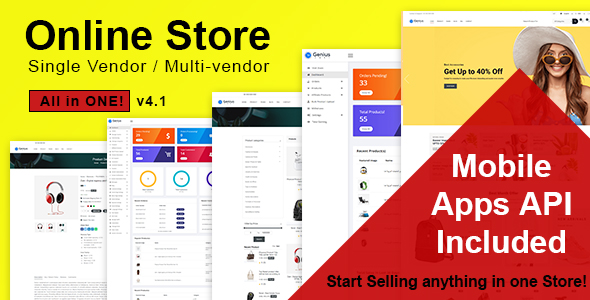
Online Store is a Laravel-based eCommerce platform sold as a PHP script on ThemeForest for $30. It bundles a single-vendor or multi-vendor storefront, an admin panel, a customer dashboard and an affiliate program into one codebase, and it is aimed at business owners, freelancers and small agencies that want to self-host a marketplace rather than rent a hosted storefront. Anyone comparing Online Store php-scripts against hosted SaaS builders should understand that this is a licence to install and run software, not a managed service.
The script comes from a vendor trading as eCommerceGenius, the same team behind the bundle branding in the listing. The sales counter is not disclosed, so there is no public purchase history to weigh up, and the marketing copy leans heavily on superlatives rather than verifiable figures. That makes an independent assessment of what the code actually promises — and what it leaves out — more useful than the listing itself.
What the Online Store php-scripts platform actually delivers
The central claim is product-type flexibility. Most store scripts assume one inventory model: physical goods with shipping, or digital downloads, or licence keys. This platform is built to sell all three from a single installation, either mixed in one catalogue or split into separate storefronts per category. In practice that means a vendor could run a fashion section, a grocery section and an ebook section under one admin login without maintaining three separate sites.
Single-vendor to multi-vendor without a migration
The admin panel includes a switch that converts a single-vendor shop into a marketplace where third parties list their own products. That is a meaningful architectural decision, because it lets a store launch as a conventional retailer and open up to sellers later without rebuilding. The vendor side of the system includes subscription plans, verification workflows, withdrawal requests and commission tracking, which are the pieces a marketplace needs before it can onboard sellers responsibly.
Selling models beyond the ordinary cart
Beyond standard add-to-cart checkout, the listing names wholesale pricing, commission-based selling and subscription-based selling. Subscription billing is the one worth flagging for evaluation: recurring payments are where most self-hosted scripts quietly fall short, and the vendor does not state which payment gateways support automatic rebilling. Buyers should confirm that before committing.
Affiliate program built into the core
Customer accounts carry an affiliate balance alongside their order history, and the admin panel exposes affiliate product management and referral reporting. The practical effect is that existing customers can be recruited as promoters without a third-party affiliate network or its monthly fee. Whether the tracking is cookie-based, how long attribution lasts and how payouts are handled are all details the listing does not specify.
Operational tooling in the admin panel
The back office is unusually broad for the price. It covers a point-of-sale interface for in-person sales, tax and country rules, shipping and packaging methods with pickup locations, coupon management, invoice handling, dispute resolution, support tickets, staff accounts with role permissions, and content management for blog posts, sliders, FAQ and contact pages. Multi-currency and multi-language settings are present, along with configurable payment gateways, social login and email templates. A secret admin login path is also mentioned, which is a reasonable hardening measure for a self-hosted install.
Customer-facing account area
Registered buyers get a dashboard showing balances, pending and completed orders, deposits, withdrawal requests and affiliate earnings. That deposit-and-withdrawal pattern is closer to a marketplace wallet than a simple order history, and it matters if vendors or affiliates are paid through the platform.
Where this platform fits and where it does not
The strongest fit is a small or mid-sized operation that wants ownership of its data and its codebase. A retailer selling physical goods alongside digital downloads and software licence keys is the obvious candidate, because the mixed-catalogue design removes the need to stitch two systems together. Freelancers building client stores also benefit: the script can be installed repeatedly for different clients, and the admin panel is broad enough to cover the operational requests that usually arrive after launch.
A second fit is the marketplace starter. Someone with an audience but no inventory can launch as a multi-vendor platform, set commission rates and subscription plans for sellers, and let the vendor verification flow handle onboarding. The affiliate layer adds a second growth channel without extra software.
The wrong choice is a large enterprise with strict compliance obligations. There is no indication of PCI DSS certification, no stated SLA, no managed hosting and no vendor support desk described in the listing. Organisations that need audited payment handling, guaranteed uptime or a formal support contract should be looking at commercial platforms with those commitments in writing, not a $30 script. The same applies to anyone who wants zero technical involvement — installing Laravel, configuring a server, setting up cron jobs and maintaining updates is assumed.
Strengths and limitations in plain terms
Strengths
- Product-type breadth. Physical, digital and licence-key inventory coexist in one catalogue, which is rare at this price point.
- Upgrade path to marketplace. The single-to-multi-vendor switch avoids a rebuild when a store decides to open to third-party sellers.
- Affiliate system included. No separate affiliate network subscription is required to run a referral program.
- Deep admin tooling. POS, tax rules, shipping methods, disputes, tickets, staff roles and content pages are all handled in one back office.
- Low entry cost. At $30 the licence is a fraction of a hosted platform’s annual fee, and the code is owned outright.
Limitations
- No disclosed sales history. The listing shows no purchase count, so there is no independent signal of adoption or of how the code behaves under real traffic.
- Payment gateway specifics are unstated. The number of supported gateways, and whether subscription rebilling works automatically with each, is not documented in the listing.
- Mobile apps are referenced but not evidenced. The copy mentions mobile apps in passing; no platform, build status or distribution detail is given, so that claim should be treated as unverified until the vendor documents it.
- Self-hosted responsibility. Security patching, backups, server hardening and Laravel version upgrades fall on the buyer. A secret admin path is not a substitute for that maintenance.
- Documentation quality is unknown. The listing does not describe an installation guide, developer docs or an update policy, all of which determine how painful year two is.
How it compares with the wider category of eCommerce scripts
The self-hosted PHP store category splits roughly three ways. At one end sit mature open-source platforms with enormous plugin ecosystems and large developer communities; they are free to license but demand real technical investment and their multi-vendor capability usually arrives through third-party extensions that must be licensed and maintained separately. In the middle are commercial scripts like this one, which ship marketplace, affiliate and subscription features in the core package and charge once. At the other end are hosted SaaS storefronts, which remove maintenance entirely but charge monthly, cap customisation and keep the codebase out of reach.
Against the open-source end, Online Store php-scripts trades ecosystem size for out-of-the-box breadth. There is no plugin marketplace to draw on, but there is also no assembly work to reach a multi-vendor, multi-currency, affiliate-enabled store. Against hosted SaaS, it wins on cost of ownership and data control and loses on convenience, support guarantees and the safety net of a platform team handling security. The honest positioning is that this is a capable starting kit for someone willing to operate it, not a turnkey business.
Frequently Asked Questions
Does Online Store support both single vendor and multi vendor stores?
Yes. The admin panel includes a setting that converts a single-vendor installation into a multi-vendor marketplace. Vendors can then be onboarded through subscription plans and a verification workflow, with commission tracking and withdrawal requests handled in the same back office. The vendor does not state whether the conversion is reversible or what happens to existing product ownership records during the switch.
What kind of products can be sold with this Laravel eCommerce script?
Physical goods, digital downloads and licence-key products can all be sold from one installation. The catalogue can mix all three in a single storefront or separate them into distinct stores per category, which suits retailers selling across unrelated verticals. Wholesale pricing, commission-based products and subscription products are also listed as supported selling models, though the subscription billing mechanics are not documented.
Is coding knowledge required to run Online Store php-scripts?
Some is required, at least for installation and upkeep. The script is built on Laravel and must be deployed to a server with a database, which means setting up hosting, configuring the environment and scheduling background tasks. Day-to-day store management happens through the admin panel without coding, but security updates, backups and framework upgrades are the buyer’s responsibility.
How much does the Online Store script cost and what is included?
The licence is $30 on ThemeForest, which covers the script itself. That price buys the admin panel, customer dashboard, affiliate system, multi-vendor capability and the selling-model features described in the listing. It does not include hosting, a domain, payment gateway merchant fees, or any managed support arrangement, since the vendor does not describe a support plan.
Verdict: who should buy Online Store php-scripts and who should walk away
Buyers who should consider it are small retailers with mixed inventory, freelancers who install stores for clients, and marketplace founders who want affiliate and vendor tooling in one package without a recurring platform bill. The $30 price and the single-to-multi-vendor switch make it a low-risk way to test a marketplace idea with real software rather than a hosted trial. Buyers who should not are enterprises needing compliance guarantees, teams with no appetite for server maintenance, and anyone who requires documented payment gateway coverage before purchase — that last group should ask the vendor directly and expect a written answer. The platform is broad and the price is genuinely low, but the absence of disclosed sales figures, unclear subscription billing and unverified mobile app claims mean it should be evaluated as a promising, lightly proven option rather than a safe default.