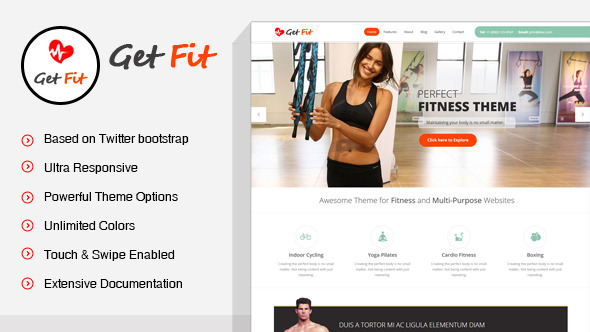
GetFit is a responsive WordPress theme built for gyms, fitness studios, personal trainers and health-related businesses, sold on ThemeForest under the miscellaneous category for $49. It combines a Bootstrap-based layout, a bundled slider plugin, a page-options panel and ready-made demo layouts aimed at fitness brands that want a polished site without commissioning custom development. It is best suited to small studios and independent trainers who need a credible web presence quickly, and it is a weaker fit for anyone whose site depends on modern booking or membership functionality.
The theme comes from developer SkatDesign and has been purchased close to a thousand times, which puts it in the modestly popular tier rather than the blockbuster tier of ThemeForest fitness themes. That sales figure matters less than it once did, because the last vendor update was in July 2019. Buyers evaluating GetFit miscellaneous today are effectively assessing a stable but ageing product, and the review below treats it that way.
What GetFit Actually Delivers Out of the Box
The core of the package is a Bootstrap grid combined with a theme options panel, which is the standard architecture for commercial themes of this generation. In practice that means layout changes are made through dropdowns and colour pickers rather than by editing template files, so a site owner with no CSS knowledge can adjust typography, spacing and colour without breaking anything. The vendor states the theme ships with unlimited colour styles, which in practice means the options panel exposes colour fields for the main theme elements rather than offering a fixed set of preset palettes.
Revolution Slider is bundled and licensed with the theme. That is a genuine cost saving, since the plugin is normally sold separately for around $15, and it gives the homepage the layered hero banners that fitness sites tend to rely on. The trade-off is that bundled copies of premium plugins often lag behind the standalone version, and the version history shows the developer repeatedly pushing slider updates, which suggests the plugin needs regular attention to stay current.
GetFit miscellaneous also includes a set of documented extras that matter more than they first appear. Ten PSD source files are provided, which is unusual at this price point and useful for anyone who wants to adapt the design in Photoshop before touching the live site. Video tutorials and extended documentation cover installation and setup. Localisation is handled properly, with .po and .mo translation files included, so the theme can be translated into any language rather than requiring string-by-string editing in the templates.
Scheduling is the one genuinely domain-specific feature. Version 1.1 added calendar and schedule functionality through the Ajax Event Calendar plugin, which is the mechanism a gym would use to publish class timetables. It is worth noting that this depends on a third-party plugin rather than being built into the theme itself, so the quality of that experience is largely outside the theme author’s control.
Where GetFit Fits and Where It Does Not
The clearest fit is a single-location gym, boxing club, CrossFit box, yoga studio or spa that needs a marketing site: a homepage with a hero banner, pages describing classes and facilities, a timetable, a trainer or team section, a gallery and a contact form with a map. The vendor tags cover exactly that spread, including aerobics, bodybuilding, boxing, crossfit and health, and the demo layouts are structured around those sections. A freelance developer building the first proper website for a local fitness business could deliver it in days rather than weeks.
A second reasonable fit is a personal trainer or small coaching business that wants a distinctive brand site with a blog for training advice. The theme’s options panel makes it straightforward to swap the colour scheme and imagery so the result does not look identical to every other installation.
Where GetFit is the wrong choice is any project that needs real membership infrastructure. There is no built-in class booking system, no recurring payment handling, no member login area and no integration with gym management platforms. A studio that wants clients to book and pay for classes online would need to bolt on a booking plugin or a membership plugin, and the theme provides no particular accommodation for that. The same applies to multi-location chains that need location switching, or to anyone expecting a block-based editing experience, since the theme predates the WordPress block editor’s arrival as the primary design tool.
Strengths and Limitations
Strengths
- The bundled Revolution Slider licence offsets a meaningful part of the $49 price for anyone who would otherwise buy the plugin separately.
- Ten PSD source files are included, which is rare at this price and useful for agencies that present designs to clients before building.
- Translation files are supplied in the standard .po and .mo format, so localisation is a real workflow rather than a promise.
- Buyer feedback in the listing consistently highlights fast, patient support from the developer, including responses within a day.
- The options panel keeps routine customisation inside the dashboard, which lowers the barrier for non-technical owners.
Limitations
- The last update was 16 July 2019. That is a long gap, and it raises legitimate questions about compatibility with recent WordPress and PHP versions, and about whether security issues in bundled components would be patched.
- Revolution Slider is bundled rather than licensed per site through the vendor’s own account, so keeping it updated depends on the theme author shipping new versions. The changelog shows this has historically been the main reason for releases.
- Class scheduling relies on the third-party Ajax Event Calendar plugin, not on theme code, so the timetable feature is only as maintained as that plugin is.
- There is no membership, booking or payment functionality, which is the single biggest gap for a commercial gym.
- Demo images are for demonstration only and are not included, so a buyer must license or supply their own photography before the site looks like the preview.
- The vendor does not state which page builder, if any, the layouts use, or whether the theme is compatible with the block editor’s full-site editing features.
How GetFit Compares With the Wider Category
Fitness themes on ThemeForest broadly split into two groups. The first is the design-led template like GetFit: strong visuals, a slider, a handful of demo pages and a theme options panel, priced under $60 and aimed at getting a marketing site live quickly. The second is the platform theme: larger packages that bundle or integrate booking, membership, e-commerce and sometimes a page builder, usually costing more and requiring more configuration.
GetFit sits firmly in the first group, and within that group its differentiators are the PSD files, the bundled slider and the reputation for support. Against newer templates in the same bracket, its main disadvantage is age. Themes released in the last few years generally ship with a modern page builder, block editor support and a demonstrated update cadence, none of which GetFit can claim. Against the platform-style themes, GetFit simply is not competing: it does not attempt to run a gym’s operations, only to present it well.
For a buyer whose priority is a well-designed, easily edited brochure site at low cost, the comparison is genuinely close and GetFit remains defensible. For a buyer whose priority is longevity and compatibility with current WordPress, the age of the last release is a real disadvantage that no amount of design quality offsets.
Frequently Asked Questions
Is GetFit compatible with the latest version of WordPress?
The vendor does not state a tested-up-to WordPress version, and the last update was in July 2019, so compatibility with current releases is unverified. The theme is likely to function on many modern installs, but buyers should assume they may need to test carefully and possibly patch minor issues themselves or through a developer.
Does GetFit include a class booking or membership system?
No. GetFit has no built-in booking, membership or payment functionality. The closest feature is a class calendar and schedule added in version 1.1, which works through the third-party Ajax Event Calendar plugin. Anyone needing online bookings or recurring memberships would have to add a separate plugin or platform alongside the theme.
Can the GetFit theme be translated into another language?
Yes. The theme ships with .po and .mo translation files, which is the standard WordPress localisation format, so it can be translated into any language using a tool such as Poedit or a translation plugin. The vendor describes the theme as multilingual ready, and the included files support that claim.
Are the images shown in the GetFit demo included with the purchase?
No. The listing states plainly that all images in the preview are for demonstration only and are not included in the theme. They require an appropriate licence to be used. Buyers should budget for stock photography or a photographer, since the demo’s visual impact depends heavily on the imagery.
Verdict
GetFit miscellaneous is a sensible purchase for a small gym, studio, spa or personal trainer who needs an attractive marketing website and is comfortable working within a theme options panel rather than a modern block-based builder. The bundled slider, the PSD files, the translation files and the developer’s support record give it more substance than its price suggests, and the near-thousand sales indicate it has worked for a reasonable number of buyers. It is not the right choice for a commercial gym that needs bookings, memberships and payments handled on-site, nor for anyone who requires guaranteed compatibility with the newest WordPress releases. The 2019 update date is the deciding factor: buyers who accept an ageing but stable codebase will be satisfied, while those who need active maintenance should look at more recently released alternatives.